
Richter Scale of Tyranny, 1/10
The Softest Glove

“The face of tyranny is always mild at first.”
—Jean-Baptiste Racine (1639-99), French dramatist1
Tyranny has often been thought of as something dramatic: iron-fisted rulers, secret police, and gulags. But tyranny rarely begins dramatically in the open. It is more often a slow encroachment, layer by layer, until what once felt like freedom becomes a carefully monitored corridor. In this new series, I propose the Tyranny Index (TI) as an analytical framework that quantifies this encroachment in ten levels, drawing parallels from political theory, economics, and literature. It measures the increasing intensity of coercion and control exercised by states over individuals and institutions, primarily through economic, political, and psychological mechanisms.
“The beginnings of all things are small.”
—Cicero (106-43 BC), Roman politician, orator and philosopher2
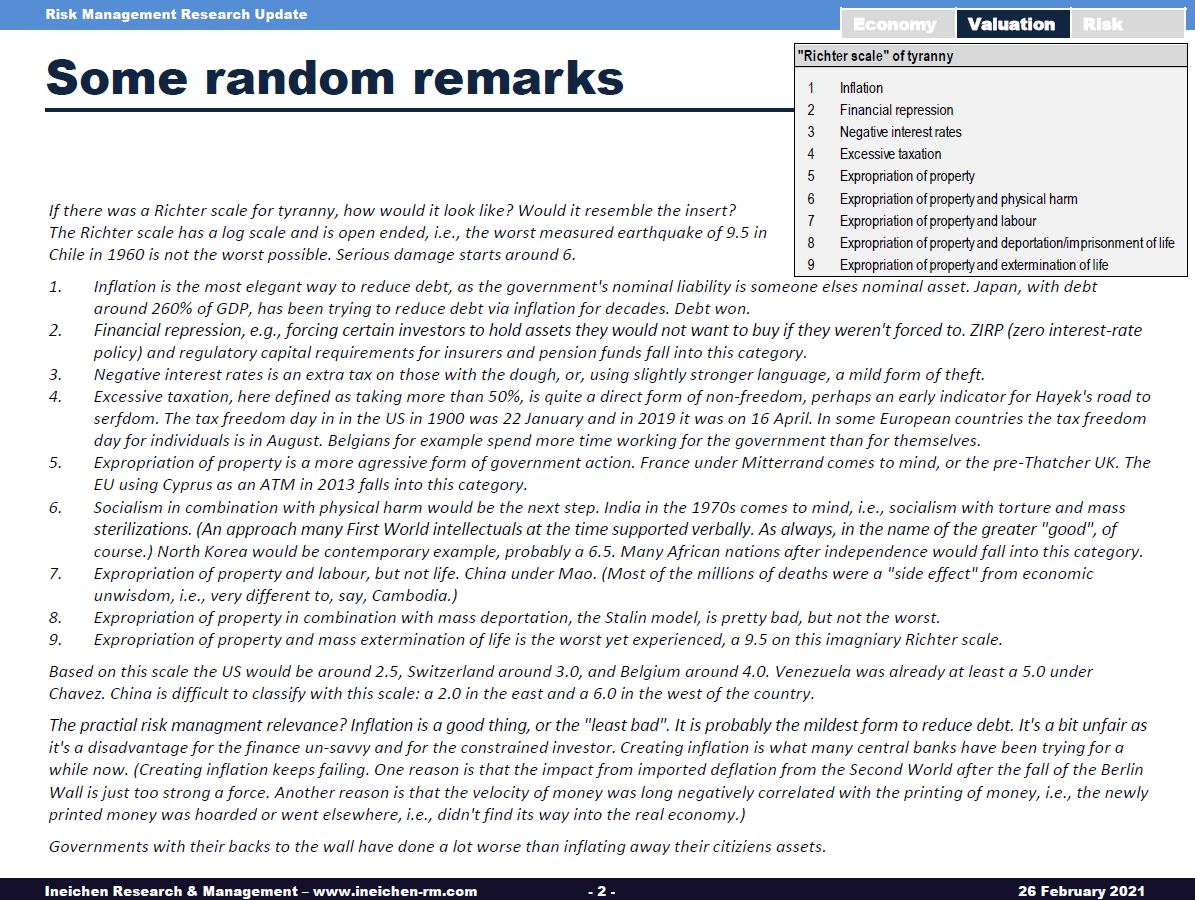
The TI has 10 levels and is inspired in part by seismological tools like the Richter Scale, gradual yet exponential, with each level representing an accumulation and escalation of tyranny, not just a linear change. Earthquakes follow a power law. The same is true for volcanic eruptions, which are measured by the Volcanic Explosivity Index (VEI). Tyranny might be similar. The TI also draws from the idea of the Breeding Pressure Gauge, where social or biological stress gradually increases until systems either adapt, break, or collapse.
“We penetrate the cabinets.”
—Klaus Schwab (b. 1938), German engineer and WEF founder3
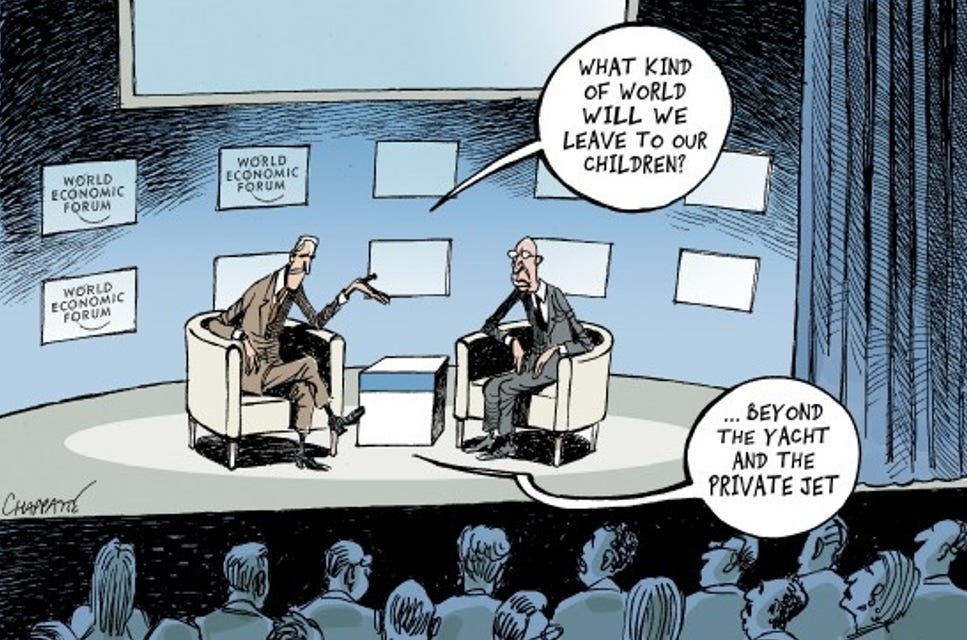
Level 1 tyranny is the most benign. It often exists unnoticed or is even rationalised as efficient governance. It involves the first hints of coercion dressed in velvet gloves. These mechanisms usually operate within legal boundaries, rarely triggering a red flag. Yet they condition individuals to accept growing state intervention as a norm.
“Inflation is the one form of taxation that can be imposed without legislation.”
—Milton Friedman (1912-2006), American economist4
At this level, economic pressures start to mount subtly. The most common is mild inflation, an invisible tax that erodes purchasing power. Inflation here is not runaway or destabilising, but steady and persistent enough to make saving a losing game for the financially unsavvy. It is unjust because it disproportionately affects the poor and the “free cash flow challenged.” The state may justify this as necessary for growth, employment, debt management, or some experimantal-cultish-utopia-about-to-turn-into-a-dystopia.
“The world would be in good shape if it were to be swissed.”
—Wendy Brown (b. 1955), American political theorist5
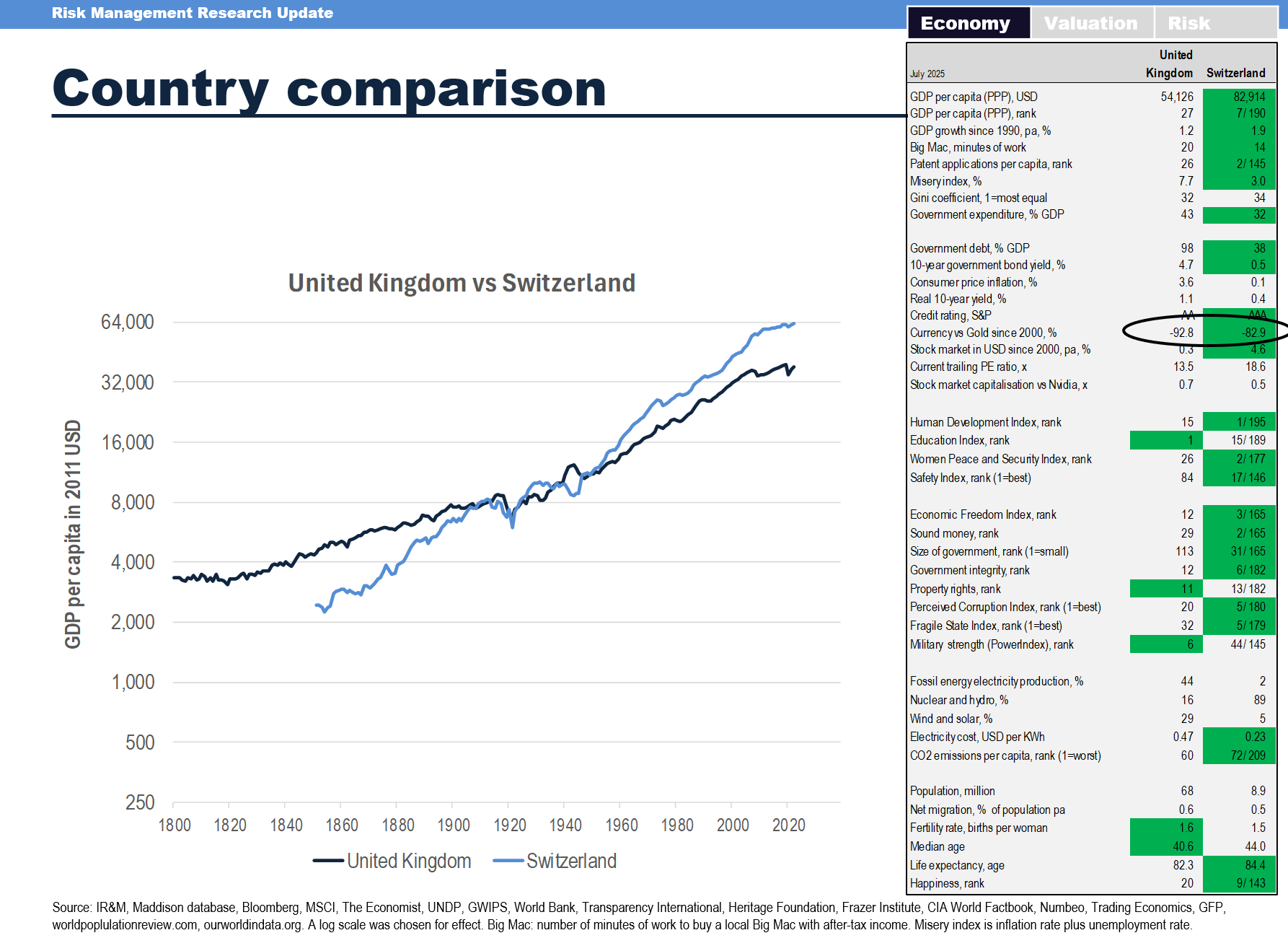
Libertarians and gold bugs often argue, it seems to this author, that all government is corrupt and all taxation is theft. However, that is not very subtle. There are differences worth pointing out. Below is a comparison between the UK and Switzerland. In this series, Switzerland is like a benchmark, not because of the handsomeness of its independent financial analysts domiciled in central Switzerland, but because of its freedom-hugging low propensity to tyranny. In 1971, it took CHF10 to buy GBP1. Now it takes only CHF1.1. The governmental “rip-off” was more extreme in the UK, when compared to Switzerland. Albeit, we do not use the word “tyranny” for mildly elevated and/or persistent inflation. At level 1, the “tyranny” is subtle.
“There is only one field where the European Union still leads the world: regulation… America innovates, China replicates, Europe regulates.”
—Greg Ip, WSJ, 31 January 2024
Politically, Level 1 may involve overregulation. Laws and procedures proliferate, often justified by safety, equity, urgency, or transparency. However, their cumulative effect is to make non-compliance inevitable, leading to selective enforcement. The law becomes a scalpel, not a shield. The aim is not to promote growth, affluence, and well-being, but to plan and control.
“Your America is doing many things in the economic field which we found out caused us so much trouble. You are trying to control people’s wages and prices—people’s work. If you do that, you must control people’s lives. And no country can do that part way. I tried and it failed.”
—Hermann Goering (1893-1946), German politician, in 1946, after reflecting6
Social and psychological control at this stage includes the beginnings of soft surveillance, algorithms that track behaviour under the guise of personalisation, and terms of service agreements that most people never read but legally bind them. Public discourse remains free, but there's a growing sense that some opinions are more welcome than others. People begin to self-censor out of caution, not fear.
“Orthodoxy is the ability to say two and two make five when faith requires it.”
—George Orwell (1903-50), British novelist, popular paraphrase on the internet7
George Orwell would identify this stage as the prelude, the subtle background conditioning before open repression. In 1984, it is the tone of quiet despair that precedes Winston's rebellion. Machiavelli, while approving of strategic deception, would warn that too much hidden control weakens legitimacy. Racine might portray Level 1 tyranny as a tragic flaw that no one notices until it is too late; a moral slumber before catastrophe.
“Men are so simple of mind, and so much dominated by their immediate needs, that a deceitful man will always find plenty who are ready to be deceived.”
—Niccolò Machiavelli (1469-1527), Italian political philosopher8
Level 1 tyranny may be gentle, but it is foundational. Like the first layer of sediment that becomes concrete, it prepares the soil for deeper roots. It is the bureaucracy that cannot be bypassed, the inflation that makes long-term planning futile, and the mild surveillance that conditions obedience. No sirens ring at Level 1, no red flags pop up, no knocks on your door at 2 am, but the walls have already started to close in.
The next chapter will explore Level 2: The Subtle Squeeze, where financial repression begins to turn economic discomfort into dependence, and the state's hand becomes firmer in both economy and speech.
Trivia (2021):
Jean-Baptiste Racine, Britannicus (Paris, 1669).
From De Finibus Bonorum et Malorum (45 BC), Book V, Chapter 58. Variant translation: Everything has a small beginning.
Klaus Schwab, interview with David Gergen on the John F. Kennedy Jr. Forum at Harvard University on February 15, 2018.
Milton Friedman, interview with Phil Donahue in 1979.
Wendy Brown, interview by Peer Teuwsen from 31 May 2018, NZZ am Sonntag, July 1, 2018.
When interviewed in jail by an American commentator, Henry J. Taylor. Congressional Record: Proceedings and Debates of the 82nd Congress, Second Session, Volume 98—Part 7, US Congress, 28 June to 7 July 1952. Written by F.A. Harper, the Foundation of Economic Education, Inc., Irvington-on-Hudson, N.Y.
Original from 1984: “In the end the Party would announce that two and two made five, and you would have to believe it. It was inevitable that they should make that claim sooner or later: the logic of their position demanded it.”
Niccolò Machiavelli, The Prince, 1513.