
The ten cannots, 3/10
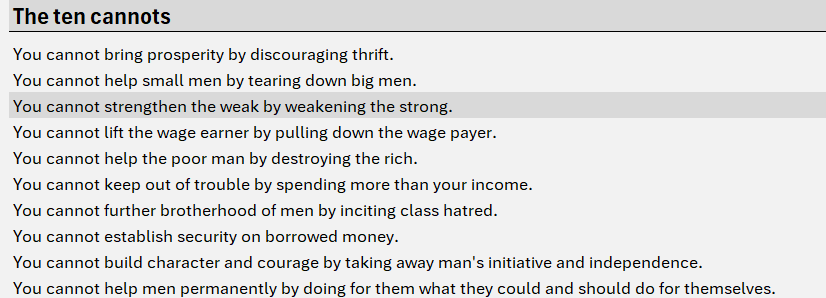
You cannot strengthen the weak by weakening the strong

You cannot strengthen the weak by weakening the strong
“It is the fundamental wisdom of the capitalist system that it functions irrespective of the wisdom or the stupidity of the capitalists.”
—Gustav Stolper (1888-1947), Austria-born German economist and politician1
The cannot, or aphorism, "You cannot strengthen the weak by weakening the strong," encapsulates a fundamental principle of capitalism that underscores the importance of fostering economic environments where success and productivity are rewarded. This principle stands in stark contrast to collective ideologies that often advocate for redistributive policies aimed at levelling economic disparities by diminishing the wealth and power of the more successful. From a macroeconomic perspective, the case for capitalism over collective ideology can be made by examining the incentives for growth, innovation, and overall economic health that capitalism promotes. Killing golden geese or constraining large parts of the productive population is, putting it nicely, counter-productive.
“It is not from the benevolence of the butcher, the brewer, or the baker that we expect our diner, but from their regard to their own interest. We address ourselves, not to their humanity but to their self-love, and never talk to them of our own necessities but of their advantages. Nobody but the beggar chooses to depend chiefly upon the benevolence of his fellow-citizens.”
—Adam Smith2
Capitalism, characterized by private ownership and free markets, inherently provides incentives for individuals and businesses to innovate and grow. These incentives stem from the potential for profit, which drives efficiency and productivity. When the strong—those who succeed in creating valuable products, services, and technologies—are allowed to reap the rewards of their efforts, it encourages others to strive for similar success, fostering an environment where economic growth is continuous.
“Increased means and increased leisure are the two civilizers of man.”
—Benjamin Disraeli (1804-81), British politician, two-times PM, and novelist3
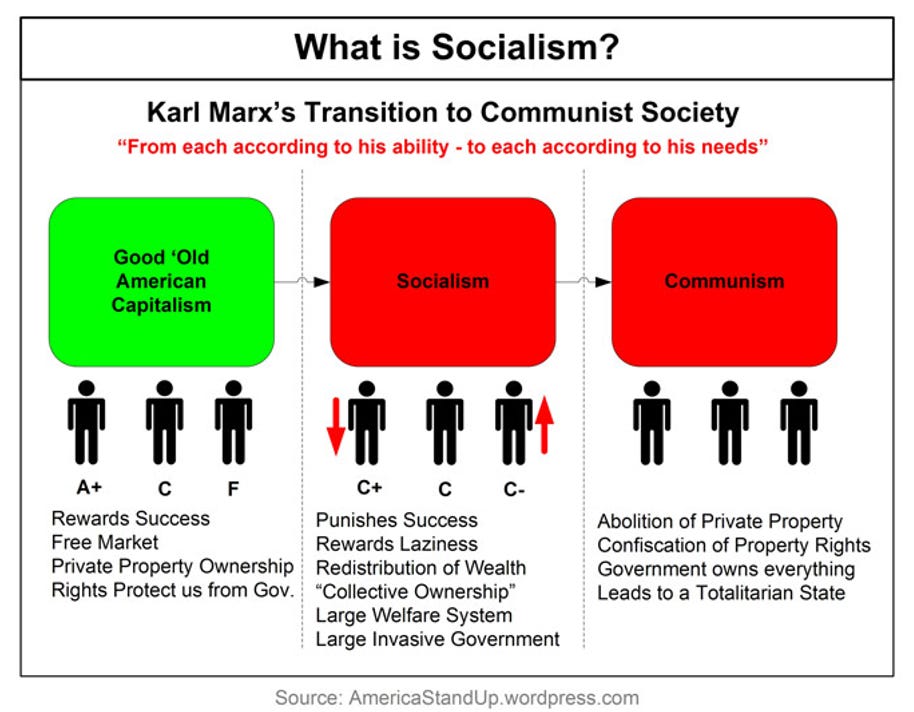
In contrast, collective ideologies often focus on redistributive policies aimed at reducing income and wealth inequality. While the intent is to uplift the economically disadvantaged, these policies can inadvertently dampen the incentives for innovation and hard work. For instance, high taxation on the wealthy to fund welfare programs can reduce the motivation for entrepreneurs to invest and expand their businesses, as the fruits of their labour are substantially diminished. This can lead to slower economic growth and fewer opportunities for the weak to improve their circumstances through employment and innovation.
“Suppose that Jones chooses a career as a poet. Jones treasures the time he spends walking in the woods and strolling city streets in leisurely reflection, his reflections lead him to write poetry critical of capitalist materialism. Working as a poet, Jones earns $20,000 annually. Smith chooses a career as an emergency-room physician. She works an average of 60 hours weekly and seldom takes a vacation. Her annual salary is $400,000. Is this "distribution" of income unfair? Is Smith responsible for Jones' relatively low salary? Does Smith owe Jones money? If so, how much? And what is the formula you use to determine Smith's debt to Jones? While Dr. Smith earns more money than does poet Jones, poet Jones earns more leisure than does Dr. Smith. Do you believe leisure has value to those who possess it? If so, are you disturbed by the inequality of leisure that separates leisure-rich Jones from leisure-poor Smith? Do you advocate policies to "redistribute" leisure from Jones to Smith—say, by forcing Jones to wash Smith's dinner dishes or to chauffeur Smith to and from work? If not, why not?”
—Economist Donald Boudreaux in the Pittsburgh Tribune-Review, 25 December 2013, found in The Gartman Letter, 20 November 2014
Innovation is a cornerstone of economic development, and it thrives in environments where there is freedom to experiment, fail, and ultimately succeed. Capitalism supports this by rewarding those who take risks and innovate. Companies like Apple, Google, and Tesla have revolutionized industries and created millions of jobs, not just for highly skilled workers but also for those in support roles. These companies started small and grew by leveraging their strengths in innovation and strategic vision.
“The quest for equality is often the road to tyranny.”
—F.A. Hayek4
Conversely, collective ideologies that emphasize equal outcomes can stifle innovation. By prioritizing redistribution over creation, these ideologies can create environments where there is little incentive to innovate. Historical examples from the Soviet Union and Maoist China illustrate this; the absence of market competition and profit incentives led to stagnation and inefficiency, ultimately weakening the entire economy. When the strong are not allowed to leverage their strengths and are instead burdened by policies aimed at enforced equality, innovation suffers, and the overall economic pie shrinks. Whether excess planning, regulation, and bureaucracy are a function of ideology, corruption, clumsiness, and/or stupidity doesn’t matter.
“When plunder becomes a way of life for a group of men living in society, they create for themselves, in the course of time, a legal system that authorizes it and a moral code that glorifies it.”
—Frédéric Bastiat (1801-50), French libertarian and politician5
Capitalism does not merely benefit the strong; it creates a dynamic economy where wealth can be generated and opportunities can proliferate. The idea is not that the strong become wealthy at the expense of the weak but rather that their success generates wealth that permeates throughout the economy. For example, the technology boom led by companies like Microsoft and Amazon has created significant wealth for their founders and investors. However, it has also led to the creation of vast numbers of jobs and secondary industries and has contributed to significant advancements in technology that benefit society as a whole.
"The more any country is governed from the center, the less liberty does it possess."
—Thomas Paine (c. 1737 - 1809), English-born American political activist, philosopher, political theorist, and revolutionary6
On the other hand, collective ideologies often lead to centralized economic planning and control, which can result in inefficiencies and a lack of responsiveness to market needs. These systems may ensure that everyone has a basic level of sustenance, but they often fail to provide the dynamism and growth necessary for significant improvements in living standards. In Venezuela, for example, attempts at extreme wealth redistribution and government control over industries have led to economic collapse, hyperinflation, and widespread poverty, illustrating the dangers of weakening the strong in an attempt to strengthen the weak.
“I am convinced that the way to build a new and better world is not capitalism. Capitalism leads us straight to hell.”
—Hugo Chávez (1954-2013), Venezuelan politician and Che Guevara fan7
In 2017, a widely cited report noted that Venezuelans lost an average of 19 pounds due to severe food shortages and economic hardship, which led to a dependence on a limited, carbohydrate-heavy diet. This situation was largely the result of soaring inflation and political mismanagement, which created an extreme scarcity of basic food items, with nearly a third of the population consuming only one or two meals per day. The weight loss, though unintended, was starkly reflective of the nation's economic collapse and humanitarian crisis. Despite this grave context, certain left-wing observers attempted to put a positive spin on the forced weight loss, framing it as a “benefit” as in “who doesn’t want to shed a pound or two.” The infatuation of the environmentalist types with de-population has no limits.
“Thanks Hugo Chávez for showing that the poor matter and wealth can be shared. He made massive contributions to Venezuela & a very wide world.”
—Jeremy Corbyn (b. 1949), British politician and Hugo Chávez fan8
The division between North and South Korea presents a striking and ongoing economic experiment in how two nations with a shared history and culture can follow radically different political and economic paths, leading to vastly different outcomes. South Korea has embraced capitalism, global trade, and technological innovation, resulting in one of the most dynamic economies in the world. Meanwhile, North Korea has remained committed to a centralized, state-controlled economy with limited interaction with the global market. The result is an economic disparity so vast that South Korea's GDP per capita (PPP) is now approximately 18 times larger than that of North Korea, despite similar starting points after World War II.
“The North Korean state was born at about the same time that Nineteen Eighty-Four was published, and one could almost believe that the holy father of the state, Kim Il Sung, was given a copy of the novel and asked if he could make it work in practice.”
—Christopher Hitchens (1949-2011), British-American journalist and social critic9
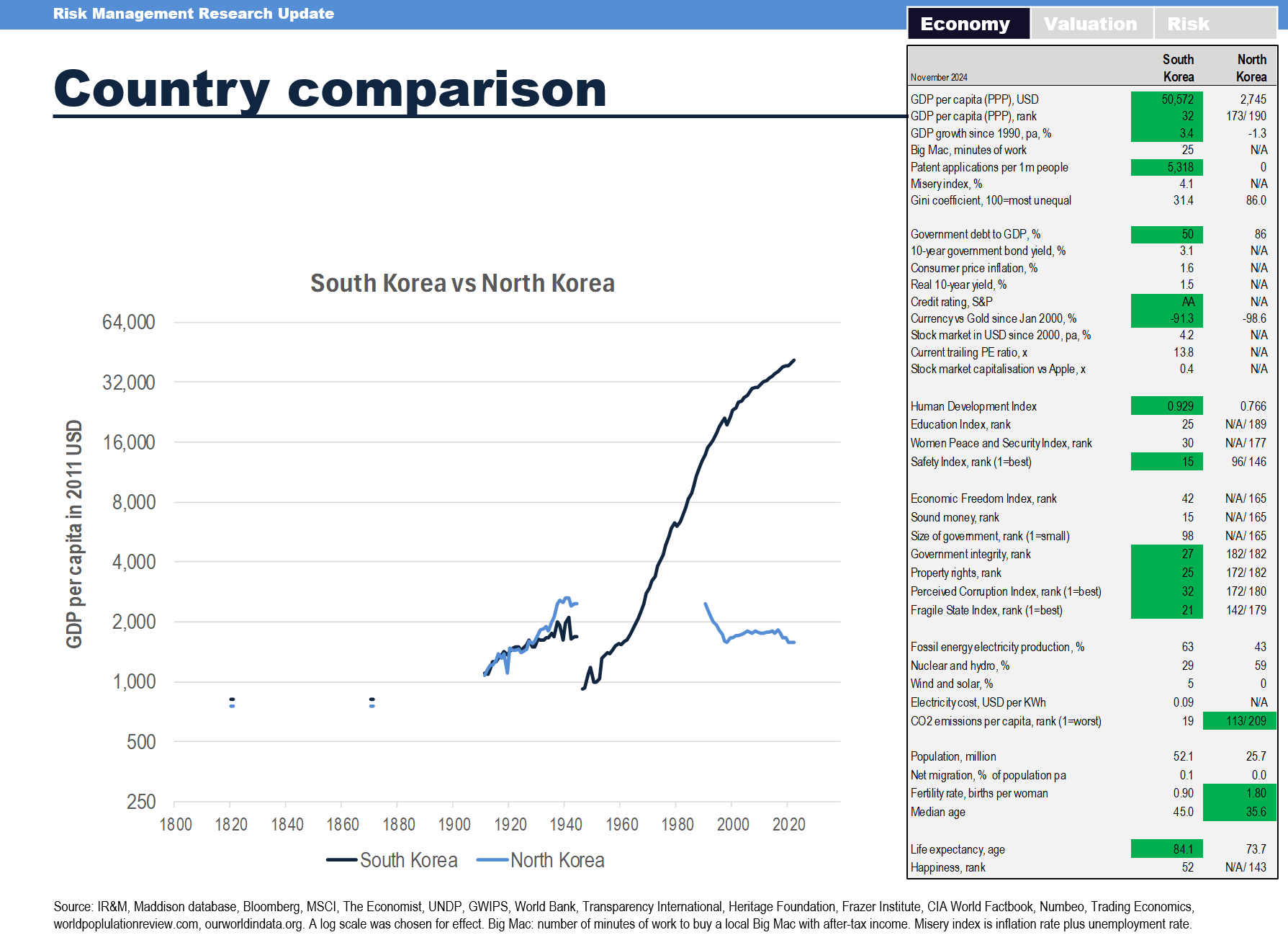
South Koreans must work an average of 25 minutes to buy a local Big Mac with their after-tax income. North Koreans don’t have Big Macs. The North Koreans live “healthier” lives, which in the West is generally called malnutrition.
“In a country where the sole employer is the State, this [opposition] means death by slow starvation. The old principle: who does not work shall not eat, has been replaced by a new one: who does not obey shall not eat.”
—Leon Trotsky (1879-1940), Marxist revolutionary10
Sadly, this last quotation is very directly applicable to North Korea. A UN nutrition assessment reported that North Korean children were up to 13 centimetres shorter and 7 kilograms lighter than their South Korean counterparts. The two Koreas split in 1945. These differences reflect the long-term effects of malnutrition, which North Korean children have faced due to severe food shortages and poor living conditions, especially during and after the 1990s famine. By comparison, South Korean children benefit from better nutrition and healthcare, contributing to their higher average height and weight as seen in similar studies from the early 2000s. This means collective ideologies are not just economically unwise but societally amoral, too.
“Will there be more assassinations in North Korea? Of course there will be more assassinations in North Korea. It’s North Korea.”
—Ian Bremmer (b. 1969), American political scientist, Twitter, 28 February 2017
The principle "You cannot strengthen the weak by weakening the strong" is particularly relevant here. Efforts to prop up North Korea through external aid or policies that might limit South Korea’s growth would likely fail to achieve meaningful improvements. Economic progress is not a zero-sum game; South Korea’s strength does not inherently weaken the North. Instead, it serves as an example of the potential for prosperity through innovation, trade, and openness. Conversely, weakening South Korea would not resolve North Korea’s systemic issues but might undermine a key player in regional and global economics. This divide continues to underscore the broader lesson that sustainable development requires empowering the weak through reforms and opportunity, not by handicapping the strong.
“I feel that sitting in a coffee shop, having a cup of tea and looking out of the window at the blue sky — this is happiness. Truly happiness. I could never have this moment when I was living in North Korea for 17 years and when I was hiding in China for 10 years. I don’t think many people, when they are having a cup of tea, go: ‘That’s freedom. It’s the joy of life.’ But me, I have that.”
—North Korean defector Hyeonseo Lee (b. 1980)11
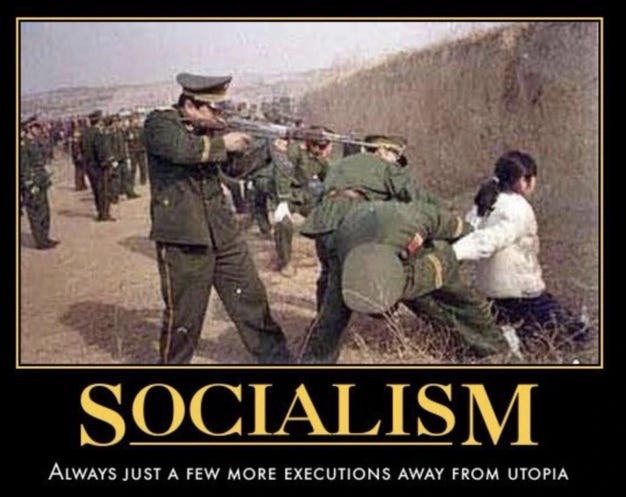
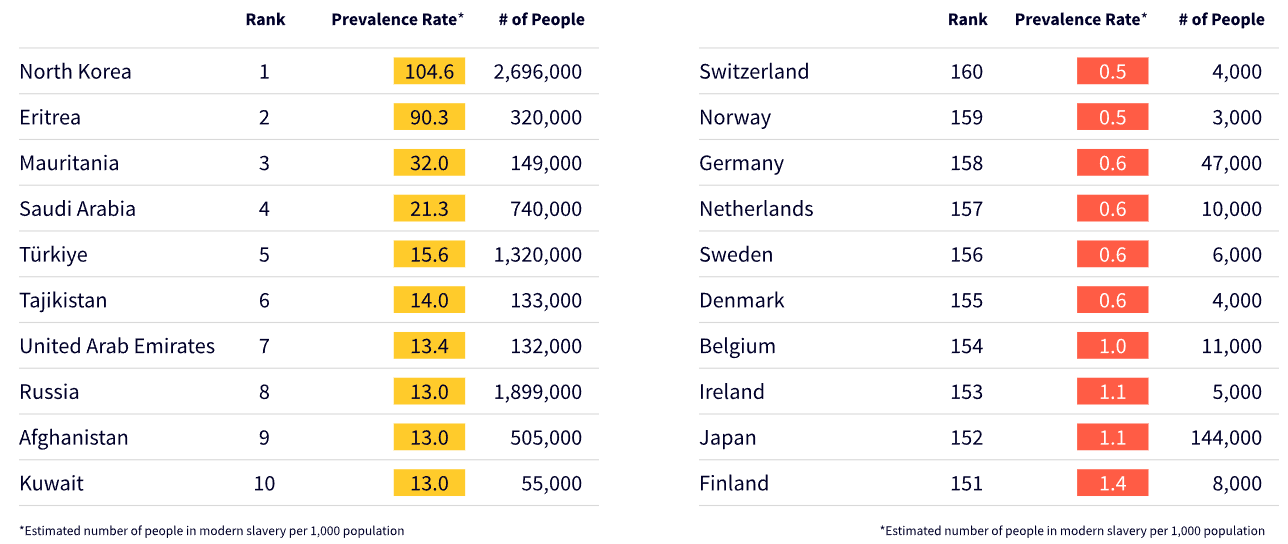
In countries without capital punishment, bad people are sent to prison. Incarceration is a punishment whereby individual freedom is reduced. Most people don’t like the reduction of freedom, which is why the incarcerated need to be locked up so they cannot escape. Welcome to North Korea, a country run by what John McCain called the crazy fat kid. (Leaders of autocracies hardly ever face malnutrition.) North Korea ranks first among 160 countries in the Slavery Index, as shown below. Collectivist ideologies are a form of punishment. This is, of course, why the governments presiding over collectivist ideologies need surveillance, censorship, and other forms of coercion or force. It is also why immigration is always towards freedom and away from oppression. No one ever said, “Let's move to Russia; that’s where the opportunities are.”
“It is important to remember that government interference always means either violent action or the threat of such action. Government is in the last resort the employment of armed men, of policemen, gendarmes, soldiers, prison guards, and hangmen. The essential feature of government is the enforcement of its decrees by beating, killing, and imprisoning. Those who are asking for more government interference are asking ultimately for more compulsion and less freedom.”
—Ludwig von Mises (1881-1973), Austrian School economist12
"You cannot strengthen the weak by weakening the strong" still holds profound implications for macroeconomic policy and the broader debate between capitalism and collective ideology. Capitalism, with its emphasis on incentives, innovation, and efficient allocation of resources, has proven to be a powerful engine for economic growth and improvement in living standards. While it is crucial to address the needs of the economically disadvantaged, doing so by undermining the successful and productive elements of society can lead to stagnation and decline. Instead, policies should focus on creating opportunities for all individuals to leverage their strengths, fostering an environment where the weak can become strong through their own efforts and ingenuity. In this way, the true potential of the economy can be realized, benefiting everyone almost everyone.
Trivia:
"Dad, why does Star Trek have a successful socialist society?"
"Because it's fiction, son."

Gustav Stolper, This Age of Fables, 1942.
Adam Smith, An Inquiry into the Nature and Causes of the Wealth of Nations, 1776.
Benjamin Disraeli, The Two Nations, 1845.
Friedrich Hayek, The Constitution of Liberty, 1960.
Frédéric Bastiat, Economic sophisms, 2nd series, 1848.
Thomas Paine, The Rights of Man, 1791.
Hugo Chávez , “Alo Presidente,” Weekly TV programme, 1 March 2005.
Jeremy Corbyn, @jeremycorbyn, Twitter, 5 March 2013.
Christopher Hitchens, God is not great – The case against religion (London: Atlantic Books, 2007), 248.
Leon Trotsky, "The Revolution Betrayed, What is the Soviet Union and Where is it Going?" 1936.
North Korean defector Hyeonseo Lee on escape and the secretive state, Lunch with the FT, Victor Mallet, Financial Times, 9 February 2017.
Von Mises, Ludwig (1996) “Human Action—A Treatise on Economics,” 4th edition. San Francisco: Fox & Wilkes. First published 1949 by Yale University. Chapter 27: “The Government and the Market”