
Use checklists, Charly said
US macro is not yet on "red alert," Captain Picard said

Charles Munger once said:
“How can smart people so often be wrong? They don’t do what I’m telling you to do: use a checklist to be sure you get all the main models and use them together in a multimodular way.”
—Charlie Munger1
New York, 15 January 2009: US Airways 1549 with 155 people on board takes off from La Guardia at 3:26pm. Two minutes later a flock of Canada geese collided with the two engines and killed both. Four minutes later Captain Chesley Sullenberger landed the plane on the Hudson River. What saved the lives of 150 passengers and five crew members was, among other things, checklists. In the four minutes in between being hit by the geese and landing the plane safely on the Hudson River there was good decision-making, i.e., the risk management procedure worked. Checklists played a central role. Gerd Gigerenzer, author of Risk Savvy, summarised the miracle as follows:
“It was the combination of teamwork, checklists, and smart rules of thumb that made the miracle possible.”
—Gerd Gigerenzer (b. 1947), German psychologist2
In that spirit, the following exhibit assesses the US economy with a set of checks. Casually one could call it a tick-the-box approach to risk management.
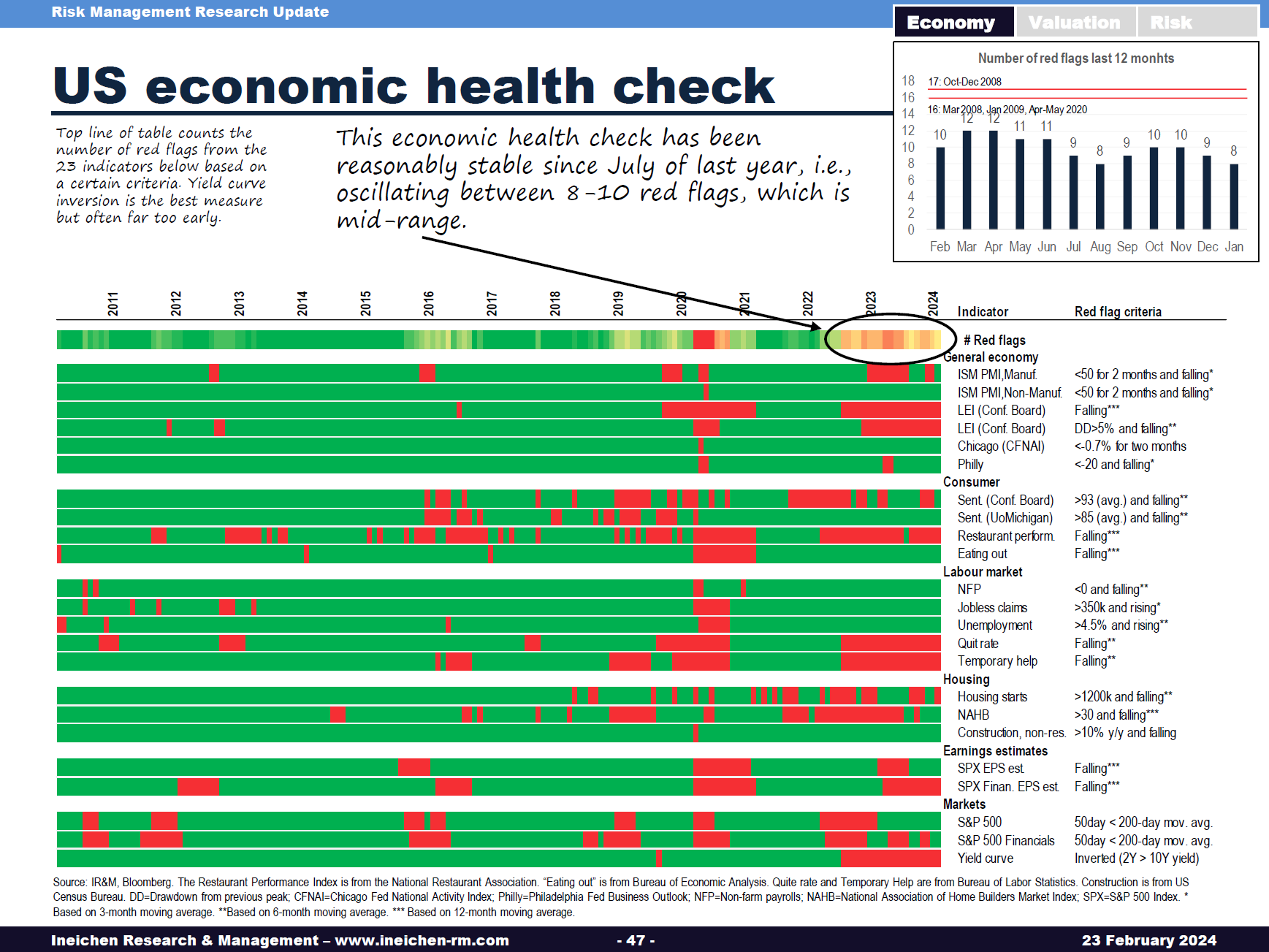
The checklist above started to worsen in early 2022 but never reached nose-bleed levels of 2008 or 2020. In Star Trek parlance it signaled “yellow alert” but not “red alert.”
The second checklist below is on US equities.
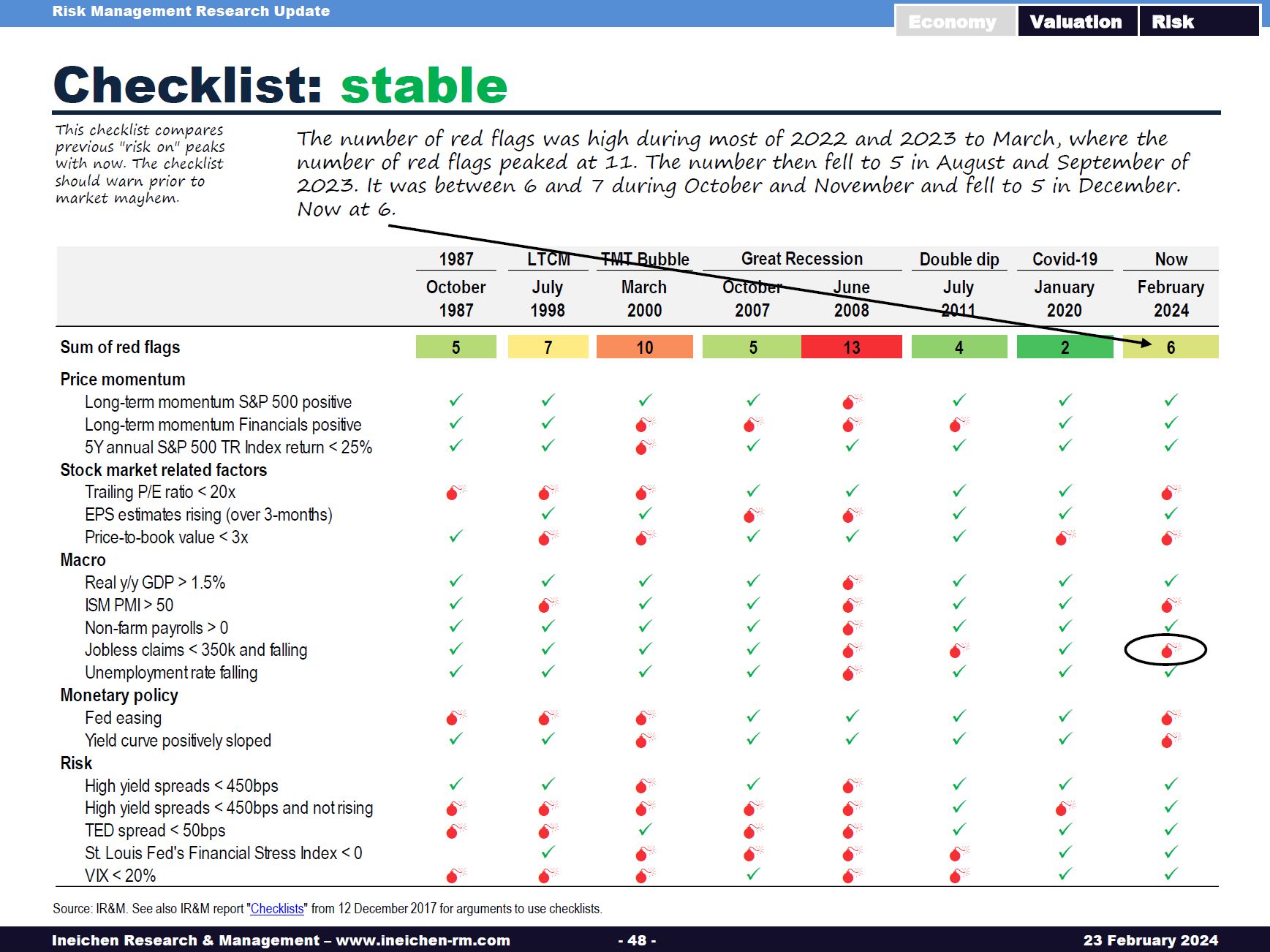
The situation is reasonably relaxed based on the variables above. There are only six red flags, from a total of 18. This compares to 13 red flags in June 2008. It goes without saying that these red flags need to warn the investor before market mayhem breaks out.
A checklist allows for a positive error culture. Akin to learning from past errors, a checklist in relation to risk management in finance institutionalizes past warning signals. It allows for more discipline and a higher degree of efficiency in asset allocation, portfolio rebalancing, and risk management.
A trend is a self-reinforcing positive feedback loop on the way up and a negative feedback loop on the way down. The key is to measure these trends in real-time. Regime tests can be helpful in this regard. A trend is a departure from randomness. This departure from randomness reduces uncertainty and therefore allows for a higher conviction in the trend. This higher conviction allows for a more efficient investment process. It allows for a speedier up or down-sizing of exposures or can reduce the costs of hedging.
Poor Charlie’s Almanack: The Wit and Wisdom of Charles T. Munger,” edited by Peter D. Kaufman, Expanded Third Edition, 2008, Virginia Beach: The Donning Company Publishers, p. 320.
Gigerenzer, Gerd (2014) “Risk Savvy – How to make good decisions,” New York: Viking, p. 29.